
A wine tank car based on European prototypes and lettered for the Sardou Winery. I started with an Roundhouse shorty flat car and added G scale barrels. I made the yokes from styrene and used chart tape for the metal strapping. I added Grandt Line nut, bolt and washer casting to hold the straps tight against the tanks.

A standard Athearn box car with a Westerfield end spliced on. A fairly simple project. These first three models I actually started 10 years ago, and now, finally getting back in to the swing of life, I am getting some of these done.

This is a basic Athearn kit with a modified dome based on an article in the September 1989 Railmodel Journal. The lettering for "Texas Natural Gasoline Corp", and "Tulsa, Oklahoma" was done with decals, one letter at a time, as there are not decals available for this prototype. AND it there are decals available, please don't tell me now.

An old Mantua kit obtained from the River Road. I added weight, some details and light weathering. As you can see, I tend to lean toward the older kits.
A 50' flat car kit from A-C. I placed a 1/8" piece of steel under the floor instead of the wood supplied. The finished weight of this car is 5.4 oz.

This is a A-C kit, supplied with metal sides and sills, cardboard for the center section, and wood end sections. I put steel inserts under the raised ends for weight, and then glued scribed wood on top. For the center section I drilled out sheet brass to replace the cardboard that was supplied. This model weighs in at 3.4 oz without a load. I built up the sloped area with styrene and used styrene for the anchor points.

 Our engineer for the day was John Spaun and one of our many Conductors/Hosts was his father, Larry Spaun. Many thanks.
 This was our other end power, since we did not have a way to turn around.
  They have a nice display of signals, some of which are shown above.
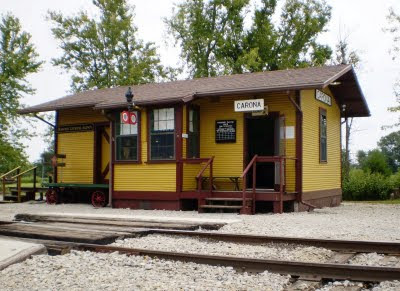
 They also have two depots on that have been restored, the ones from Corona and the Boston.


 And a critter
 Rolling stock


 And a critter
 Rolling stock


 This is an Ambroid kit based on the StPM&M prototype from the late 1800’s, I am going to reletter it for my home road M of W department. This is a double decker dormitory car. The cables hanging on the sides were used to tie the car down so it would not blow over. Also note the shelf for storage under the car. Ambroid kits are mostly wood with some metal castings. The kit, as supplied, came with windows printed in black on clear plastic. I thought that looked very poor, so I made each window individually, from styrene strip. There are 16 double hung windows on the lower lever and each contains 16 parts, and the 32 upper windows have 12 pieces each, or a total of 356 pieces. Building and installing windows probably took longer to build than all the rest of the project. I think I am going to glaze the windows with Microscale Krystal Clear, and add another stove to the other end to “modernize” the car for the Nirvana Valley Railroad.
  Below is a Silver Streak Frisco box car, this was assembled by Mike Stephens of beautiful Joplin, MO.
 Speaking of vintage, this is a Megow kit. Probably dates back to the 40’s? This kit was comprised of paper sides and ends, zinc hopper castings and trucks and wood for most other pieces. I, however, did not use any wood. I laminated the sides to styrene, and used styrene strips for all the wood parts except the main floor piece. The main floor is made of a piece of 1/8” steel with styrene strips glued around the edge. This provided weight and a good gluing surface. I have lots of construction pictures for this project, and hope to post those later, and have a clinic on building old wood, metal and papaer side craftsman kits.


